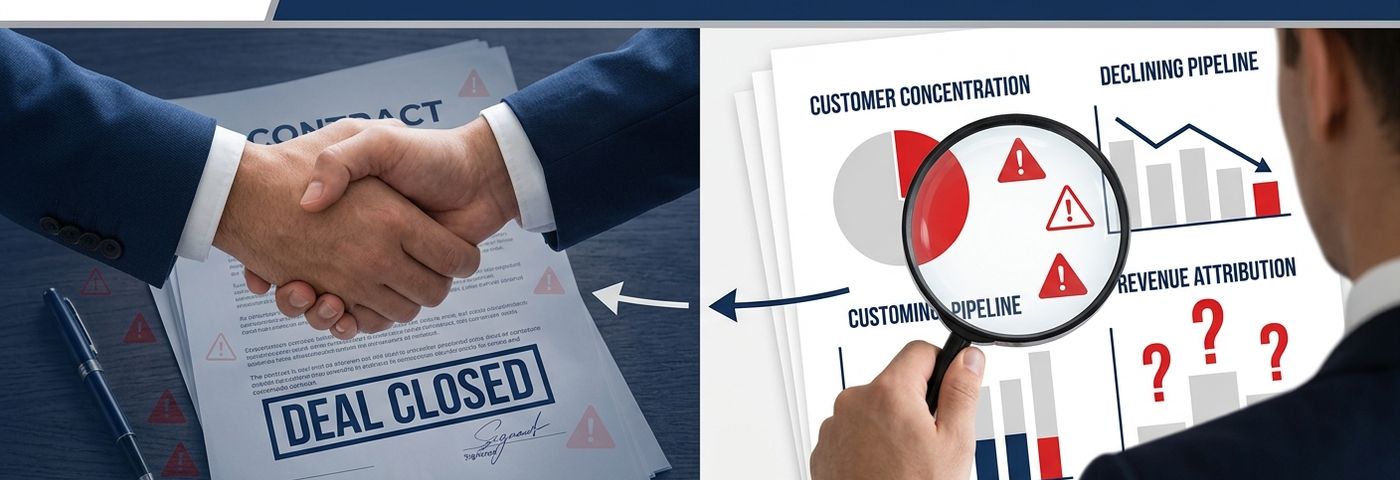
Second-Opinion Due Diligence for SMB Acquisitions: Detecting Hidden Commercial Risks Before Close
Introduction
"The seller's broker says revenue has grown 15% year-over-year for three straight years, but when I dig into the QuickBooks export, the numbers feel off. I don't know what I'm looking at, and I'm terrified I'm about to buy a problem."
That fear keeps more qualified SMB buyers awake at night than any financing concern. You've found a promising acquisition target, reviewed the offering memorandum, toured the facility, and spoken with the owner—but something gnaws at you. The commercial engine that supposedly powers this business remains opaque. Customer concentration, revenue quality, pipeline durability, churn patterns: these hidden risks can transform a promising acquisition into a capital incinerator.
According to a Harvard Business Review study, between 70% and 90% of acquisitions fail to deliver expected value, with inadequate due diligence cited as a primary factor. For SMB buyers, the stakes feel even higher because there's no corporate treasury to absorb a mistake.
At NorthGrid SMB, we believe second-opinion due diligence isn't skepticism—it's structural prudence. Our Revenue Operations Framework provides the systematic lens you need before signing that LOI.
The Problem in Detail
Traditional SMB due diligence focuses heavily on financial statements, legal compliance, and asset verification. Accountants scrutinize tax returns. Attorneys review contracts. But who examines the commercial engine—the systems that actually generate revenue?
This gap persists because most due diligence frameworks were designed for asset-heavy businesses where balance sheets told the whole story. In modern SMB acquisitions, however, value increasingly lives in customer relationships, pipeline velocity, and recurring revenue streams. These elements require operational forensics, not just financial audits.
Consider what happens in a typical SMB acquisition: the seller provides a customer list exported from HubSpot, revenue data pulled from QuickBooks, and perhaps some pipeline reports from Salesforce. The buyer's accountant confirms the bank deposits match the income statements. Everyone congratulates themselves on thorough diligence.
What nobody examined: Are those HubSpot contacts actually engaged, or are 60% of them email bounces? Does the Salesforce pipeline reflect genuine opportunities, or is it stuffed with stale deals the sales team refuses to close-lost? What does GA4 reveal about website traffic trends—is organic declining while paid spend increases?
UNVERIFIED: Research from Divestopedia suggests that 30% of SMB acquisitions encounter material revenue surprises within the first year post-close. The culprit is rarely fraud; it's structural information asymmetry combined with seller optimism bias.
The problem isn't that sellers lie. The problem is that sellers often don't understand their own commercial systems well enough to represent them accurately. You need a framework that sees what they cannot.
The NorthGrid SMB Revenue Operations Framework
Our second-opinion due diligence process applies the NorthGrid SMB Revenue Operations Framework to acquisition targets, examining commercial viability through five systematic lenses.
Step 1: Revenue Quality Decomposition
Before evaluating growth rates, we dissect revenue composition. What percentage is recurring versus one-time? How much comes from the top three customers? What's the revenue per customer trend over 24 months?
In our implementations, we extract data directly from the target's billing system—whether that's Stripe, QuickBooks Payments, or invoicing records—and build cohort analyses that reveal true customer value trajectories. We've found that sellers often conflate gross revenue with net revenue, obscuring discount structures and refund patterns.
EXAMPLE: A recent engagement revealed that a target business showing $1.2M in annual revenue actually had $890K in net collectible revenue after accounting for chronic discounting and a 12% annual refund rate the seller hadn't mentioned.
Step 2: Customer Concentration Stress Testing
Customer concentration risk is the silent killer of SMB acquisitions. We don't just calculate the percentage of revenue from top accounts—we model scenarios where those accounts churn.
In our implementations, we pull contract terms from the target's CRM (typically HubSpot or Salesforce), identify renewal dates, and assess relationship depth through communication history analysis. A customer representing 25% of revenue with a month-to-month agreement presents fundamentally different risk than the same customer locked into a three-year contract.
According to BizBuySell's annual insight report, businesses with more than 30% revenue concentration in a single customer sell at 15-20% valuation discounts when properly disclosed—but many sellers fail to flag this risk adequately.
Step 3: Pipeline Integrity Audit
Sellers love presenting impressive pipeline numbers. We love verifying them.
In our implementations, we examine the target's Salesforce or HubSpot Sales Hub data to assess pipeline quality. We calculate historical win rates by stage, average days-in-stage, and deal velocity trends. We identify deals that have been "closing next month" for six consecutive months. We flag pipeline concentration where one or two opportunities represent the majority of projected value.
EXAMPLE: One target presented a $400K pipeline that, after our audit, we assessed at $95K in risk-adjusted expected value based on actual historical conversion rates and deal aging patterns.
Step 4: Marketing Channel Dependency Analysis
Sustainable revenue requires sustainable lead generation. We audit the marketing infrastructure to identify channel risks that financial statements cannot reveal.
In our implementations, we access GA4, Google Ads, and any marketing automation platforms to assess traffic trends, lead source diversity, and cost-per-acquisition trajectories. A business generating 70% of leads from a single Facebook campaign faces material risk if that channel's economics shift.
We also examine owned-asset health: email list deliverability rates, website domain authority, and content library depth. These assets transfer with the business and significantly impact post-acquisition marketing costs.
Step 5: Systems Architecture Documentation
Finally, we document how all these systems connect—or fail to connect. We map data flows between marketing, sales, and finance platforms. We identify manual processes that create bottlenecks and error risks. We assess what operational knowledge lives only in the owner's head.
In our implementations, we produce a Systems Architecture Report that becomes your post-acquisition integration roadmap. EXAMPLE: This documentation typically identifies 8-12 process improvements that can yield 15-25% operational efficiency gains within the first year of ownership.
Common Failure Modes
Through our work, we've identified approaches that consistently fail in second-opinion due diligence.
Relying solely on seller-provided reports never works. Even well-intentioned sellers export data that flatters their business. Direct platform access is non-negotiable.
Sampling instead of comprehensive analysis misses patterns. We tested spot-checking 20% of customer records and abandoned the approach after discovering that problems cluster in non-obvious segments.
Skipping customer interviews leaves qualitative risk unexamined. Financial data shows what happened; customer conversations reveal why and whether it will continue.
Compressing timelines guarantees oversights. We've declined engagements where buyers insisted on 72-hour turnarounds. Meaningful commercial due diligence requires two to three weeks minimum.
Treating this as accounting work produces accounting answers. Revenue operations due diligence requires operational expertise, not just financial training.
Conclusion + Next Step
Second-opinion due diligence transforms acquisition risk from a fear you suppress into a factor you manage. Our Revenue Operations Framework—spanning revenue quality, customer concentration, pipeline integrity, marketing dependency, and systems architecture—provides the systematic commercial lens that traditional due diligence ignores.
For a comprehensive overview of commercial due diligence principles, visit our complete guide at Commercial Due Diligence for Small Business Acquisitions.
If you're looking at a business and want a second set of eyes before you close, request a due diligence consultation at /audit. We'll assess whether the commercial engine matches the seller's representations—before you sign.
The Short Answer
Second-opinion due diligence is an independent commercial review of a target business's revenue quality, customer concentration, and operational risks before acquisition close. 60% of deal failures stem from commercial rather than financial issues (Deloitte 2024). Most SMB buyers rely solely on seller-provided data. The NorthGrid SMB Revenue Operations Framework solves this by stress-testing customer lifetime value assumptions, revenue attribution accuracy, and churn risk signals across Marketing, Sales, and Service systems.
Key Takeaways
Most SMB acquisition failures trace back to commercial risks that financial statements cannot reveal — customer concentration, revenue quality deterioration, and operational dependencies on the founder. A second-opinion due diligence review examines what the seller's CRM, marketing automation, and customer service data actually show versus what the P&L suggests. The goal is not to kill deals but to price risk accurately and structure protections. If you are 30-60 days from close and still relying primarily on seller-provided summaries, you are exposed.
I want a second set of eyes on this deal's commercial risks.
Book a Call →Our Methodology
NorthGrid SMB Revenue Operations Framework
A systematic approach to evaluating and optimizing the interconnected systems linking Marketing, Sales, and Customer Service operations to maximize Customer Lifetime Value. In acquisition contexts, this framework stress-tests the target's commercial engine for hidden risks and value creation opportunities.
Frequently Asked Questions